February 4, 2022 - 12:06pm UTC

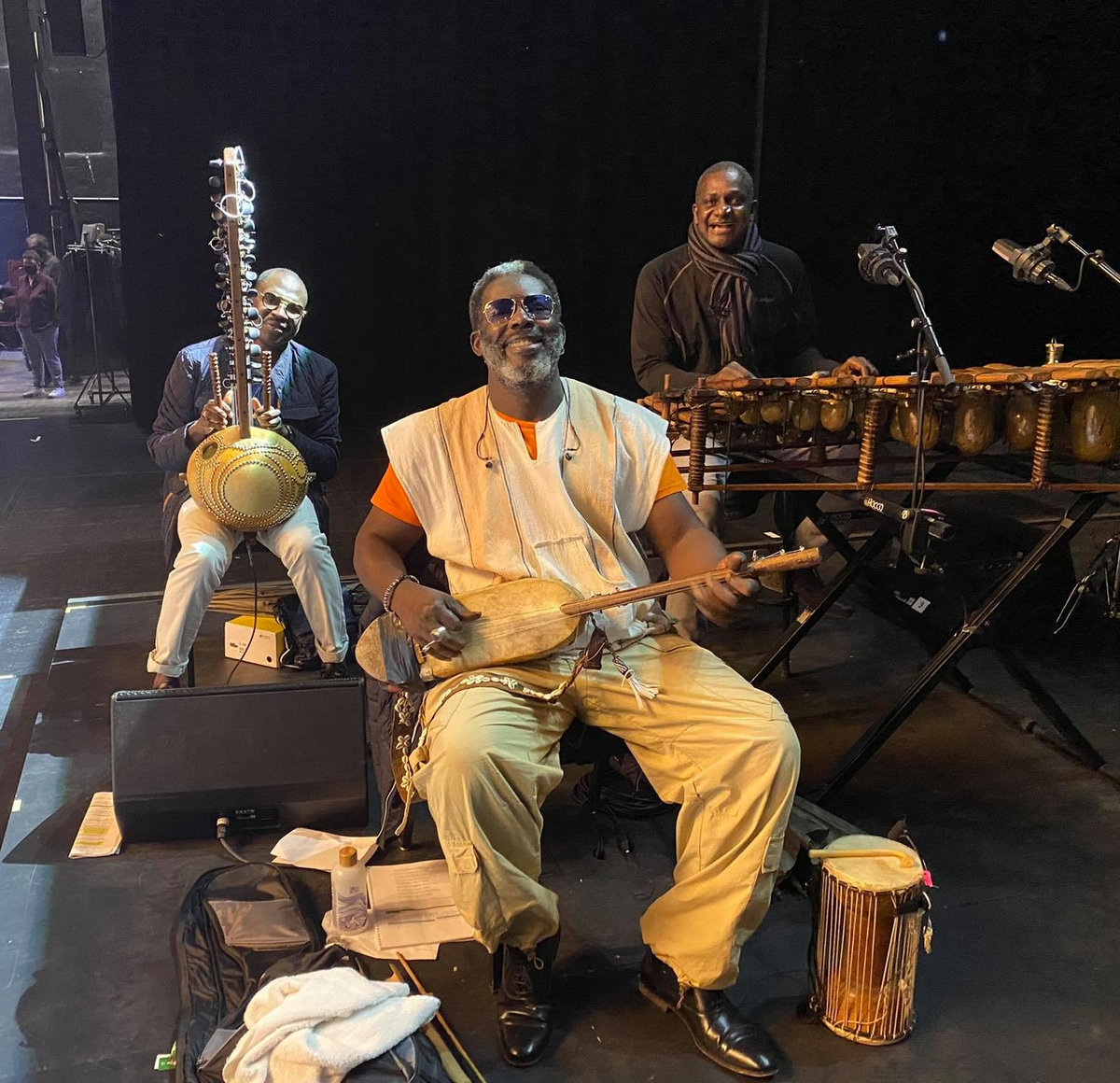
Baba Sissoko’s Griot Jazz project was born during the residency for the production of the opera Le Vol du Boli at the Théâtre du Châtelet in Paris, where three Malian musicians were involved, Baba Sissoko and Lansiné Kouyaté, already popular in Europe (the former lives in Italy, the latter in France) and the younger Madou Sidiki Diabate, who still dwells in Mali. The three of them always played together, every day, before rehearsing as well as during the intermissions, and a month later Sissoko had written material enough to feel the need to record it before everyone went back home.
Lansiné Kouyaté, who lives in Paris, booked the studio of a friend musician, Jean–Philippe Rykiel, a French keyboardist blind since his birth in 1961 who, listening to them rehearse, felt the desire to sit at the piano and play with them. His keyboard blended perfectly well with the trio’s music, so much so that he was asked to join the group. The great freedom at interpreting African music, Rykiel’s creative keyboard as well as the wide space left for improvisation link Mali’s music with jazz, and it’s not by chance that the title track, Griot Jazz, is perhaps the best example of that fusion.
Even though it was born by chance, the project doesn’t sound that casual. Rykiel, a wonderful pianist but also an esteemed arranger and producer, collaborated with Jon Hassell and Leonard Cohen but most of all with Salif Keita and Youssou N’Dour, with whom he co–produced three albums. Besides, he also recorded as a duo with Kouyaté, who in turn played with Keita and Dee Dee Bridgewater. Such experiences are analogous to the ones lived by Baba Sissoko, who has always been drawn to jazz, ever since his first experiences with the Art Ensemble of Chicago.
Griot Jazz has become a very successful project. The fifteen pieces that compose it flow smoothly, without hitches, and traditional African instruments know how to search for new and original sounds with Rykiel's keyboards, often managing to find them.
TRACKS include:
1) Sini Ka Dja
2) Griot Jazz
3) Dala Manka
4) Angafoli
5) Abderrahmane
6) Griot Groove
7) Fatoumata
8) Gherena
9) Kamissoko
10) Uyaye
11) Thierno
12) Mamela
13) Dorcy
14) Nour
15) Castella
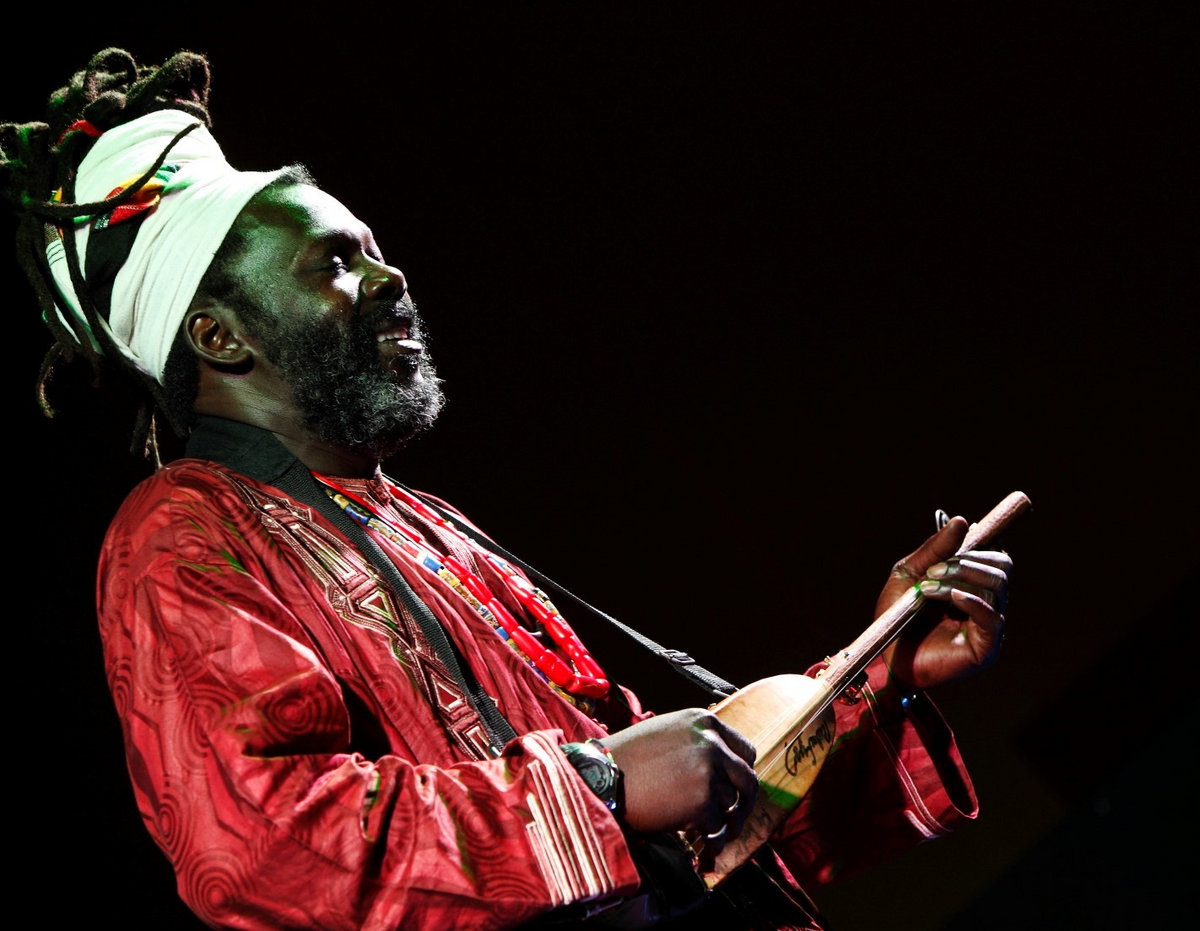
Born in 1963 in in Bamako (Mali), Baba Sissoko is the undisputed master of tamani (the original talking drum), that he started to play as a child at weddings and other traditional ceremonies. He is able to extract all the notes simply with a one, natural movement. Baba Sissoko also plays ngoni, kamalengoni, guitar, balaphon, calebasse, and he sings!
In 1985, Sissoko toured internationally with the prestigious Instrumental Ensemble of Mali orchestra, playing tamani and ngoni. In 1991, he founded his trio, Baba Sissoko & Taman Kan, and began extensively collaborating with top Malian artists and international musicians. His work with Habib Koité is notable as their collaboration lasted 12 years and was widely celebrated. In 1995, Baba Sissoko released his first album with Taman Kan.
Baba Sissoko is from a great and ancient dynasty of griots from Mali: in the Malian tradition, griots are reputed to calm down hearts and souls, by means of music. Baba Sissoko has been the first one to introduce the sound of tamani in the modern music of Mali. In his compositions, there is a great influence of Amadran, that is a repetitive and hypnotic musical structure typical from Mali by which, according to many researchers, blues was born.
His style is peculiar: Baba loves to integrate melodies and rhythms of the Malian tradition (Bambara, Peul, Mandig e Sonrai) with the typical sounds of jazz and blues, creating fantastic musical effects. This also thanks to the numerous experiences with other musicians belonging to cultures and roots completely different from his background. Besides his many collaborations, he leads many different musical bands.
Baba Sissoko once explained who is a Griot, and how they are considered as a natural library. “There are many ways to understand who a Griot is…I myself, Baba, can talk about my family, but also on behalf of all griots in the world. Griot, in Bambara (i.e. the language of my country, Mali) is Djeliya, which means humankind; Djeliya also means nobleness and ‘he who has a gift for eloquence.’ A griot is a very clever person, from any viewpoint. The Djeli (griot) was the strength of the family, i.e. the kind of strength which exists when respect, understanding and harmony are present.
There are four types of griots:
1) The father is the symbol of the family; 2) The mother epitomizes the foundation of the family; 3)The eldest son follows his father and succeeds him while the other children follow him; 4) The eldest daughter follows her mother. The griot’s task is the harmonization of souls and hearts. He can soothe the spirits in case of war, he arranges marriages; kings and generals trust him; he educates children.
The griot transfers his secrets and knowledge to one of his children; he usually teaches the traditions to his eldest son. His learning process begins during the baptism ceremony, when the selected child starts following his father and learning how to play the tamani.”
Baba Sissoko's Griot Jazz is being released by Caligola Records, founded in 1994 in Venice, Italy, within a cultural association of the same name that was already known for promoting jazz concerts there since 1980. In 2003, Caligola Records became totally independent by acquiring the music publishing company Elicona Edizioni Musicali, and the label intensified its already rich, varied musical production. Caligola Records' catalogue gives voice to contemporary jazz, by its nature infinitely curious and omnivorous. One of Caligola's strenghts is certainly its historic collaborations and relationships with jazz musicians, both well established and emerging. After nearly three decades, Caligola's catalogue now has more than 300 titles, is exclusively distributed by IRD, has its own shop, and is a brand of Elicona Edizioni Musicali, a music publishing and record company which also organizes concerts and provides services for the entertainment industry.